
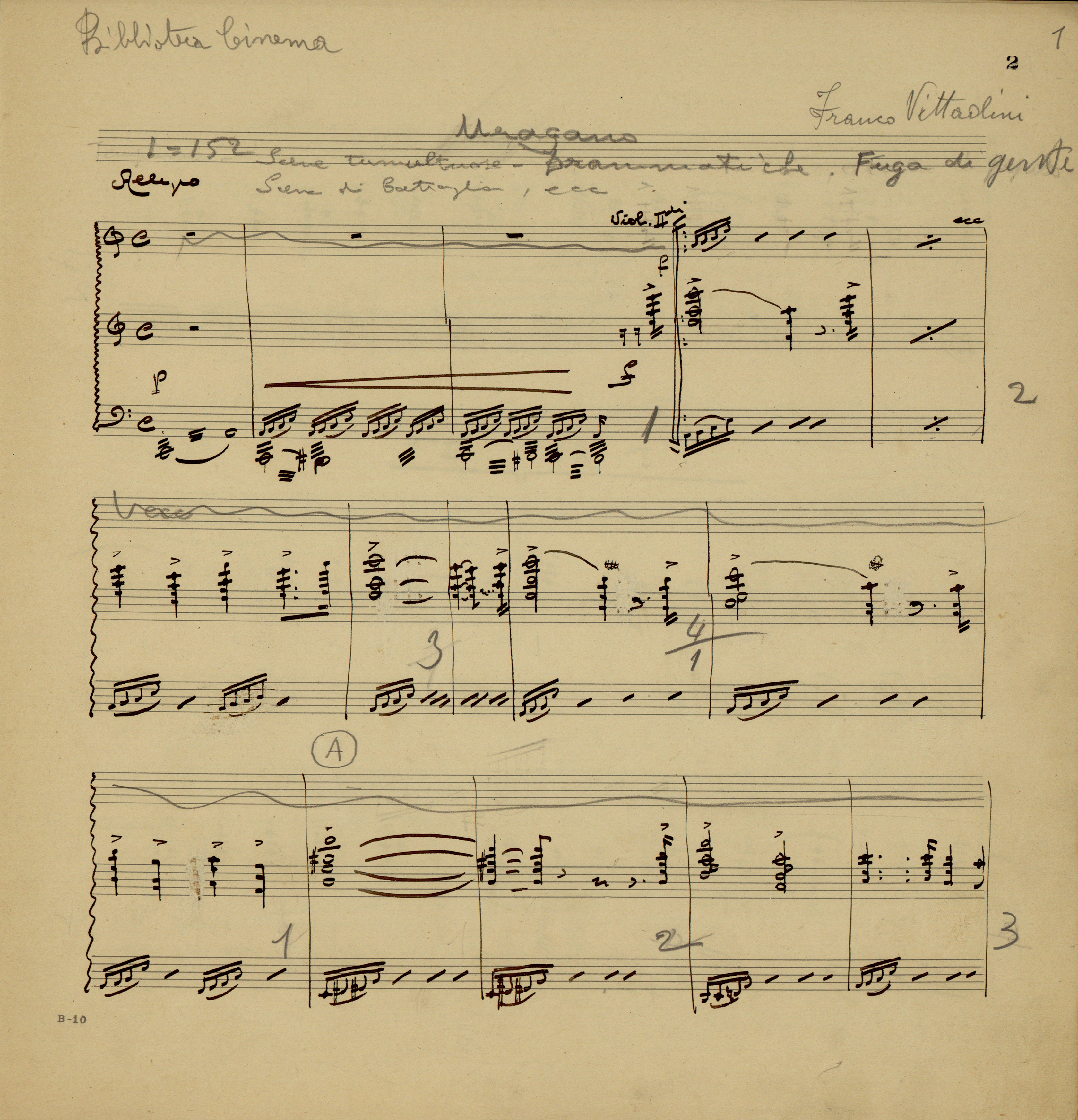
The notion of ‘source’ poses considerable problems for the study of silent film music. On the one hand, from a purely historical point of view, it is worth remembering that most of the music for the films of the silent era no longer exists. On the other hand, a vast repertoire of stock photoplay music has come down to us from the silent era, as an example of specialised publishing in the field of film music. Collections such as Kinothek, Motion Picture Moods, Filmharmonie, and many others consisted of original pieces that were not associated with a specific film but were designed to fit into standard narrative situations or to provide a common emotional aura. The practice of reusing and re-functionalising mood music pieces, constantly hovering between composition and compilation, raises philological questions concerning the multiple definition of the musical text, its author, and its performance. The score of a piece of stock photoplay music is not, in fact, the source of an opus in the strict sense of the term. It is not an aesthetically grounded entity, but rather an operational instruction at the service of a subsequent creative act: the one that will shape the musical accompaniment of a particular film screening in the cinema. The ubiquity of photoplay music is not the exception, but the rule. Indexing and cataloguing a source of stock photoplay music is not in itself useful historical knowledge if it is complemented by knowledge of its adaptive uses. These, however, are not to be found in the primary source, but must be reconstructed by consulting secondary sources of various kinds, from cue sheets to journalistic reviews, which only in their constellation give an account of the cinematic show as a whole.
Francesco Finocchiaro, Photoplay Music as Key Source for a New Historiographical Paradigm, «Fontes Artis Musicae», LXXI n. 2, April-June 2024, pp. 63-84.
 FMJ Project
You must be logged in to post a comment.