Cluj-Napoca, 19 November 2024


“When it comes to blockages and obstacles in the research process, we must distinguish between difficulties or obstacles that may arise in the course of the investigation for argumentative reasons and obstacles of a personal nature. The former are actually the easiest to solve because they are natural and inherent to the epistemology of scientific research: scientific research progresses through successive adaptations. In very rare cases, a research project ends with the achievement of all its objectives, and precisely those objectives that were set at the planning stage. And that’s a good thing, because it means that the researchers did not proceed blindly, but took into account the evidence they encountered along the way.

However, since problems can arise at any time, it is always a good idea for a research project to have both short-term and long-term goals: to analyze a problem, a difficulty, to break it down into parts, segments, steps to be tackled one by one. This is the right strategy to overcome blockages and obstacles of any kind and not to be paralyzed by the enormity of the problems.

On the other hand, difficulties of a personal nature are not to be underestimated and are becoming more and more frequent. Blockages or paralysis, even for long periods, can be due to insecurity, fear, feelings of inadequacy resulting from the constant confrontation and extreme competition in which research is carried out today. There is a level of ambition that is often excessive and disproportionate to the actual knowledge of researchers who, until proven otherwise, are at the beginning of their careers. On the other hand, there is an urge to compete, a true and proper agonism that is taken to the extreme in academic environments where evaluation is based on mere arithmetic calculations of the number of publications, the number of conference papers, and other criteria that are not qualitative but purely quantitative.

The motto “publish or perish” is a phrase of despair. Our watchwords should be: humility instead of ambition, gradualism instead of precociousness, slowness instead of haste, rigor instead of the frenetic rhythm imposed by the desire to meet the next deadline.

It is not surprising that, in predisposed individuals, the mixture of ambition and agonism can be fatal, leading to real psychological disorders such as anxiety, panic attacks and, in the most severe cases, paranoid forms such as the impostor syndrome, typical of those convinced that they are not up to their role, or the false victimization syndrome, typical of those convinced that they are being persecuted by their colleagues or supervisors and who see in every gesture a sign of persecution against which they believe they must defend themselves. It is therefore not uncommon for even the correction of a thesis by a supervisor or the rejection of an abstract for a conference to be experienced as moments of discrimination, mobbing, persecution, or worse.

The biggest problem is that even the most titled academics who may end up in a position of responsibility often have no expertise in these matters and no tools to decipher these behaviors, so they often react with blatant incompetence.”

Francesco Finocchiaro – Cristina Pascu, Musical Research: Trends, Methods, and Contemporary Challenges, 19 November 2024, National Academy of Music “Gheorghe Dima”, Cluj-Napoca

The Institutionalized Lie

Die institutionalisierte Lüge ist das Wesen eines totalitären Regimes: eines Regimes, das nicht nur das Gedächtnis umformt und Informationen manipuliert, sondern durch die Neuschöpfung der Sprache das Kriterium der Wahrheit selbst zerstört. Der Staat, die Institution, oder auch die Akademie, die gewaltsam die These einer Minderheit über die Mehrheit stellt, handelt nach einer totalitären Logik: ein schonungsloses Vorgehen, eine mafiöse Macht, die kein anderes Grundgesetz kennt als das Führerprinzip.

The institutionalized lie is the essence of a totalitarian regime: a regime that not only reshapes memory and manipulates information, but also destroys the very criterion of truth by recreating language. The state, the institution or even the academy that violently places the thesis of a minority above the majority acts according to a totalitarian logic: a ruthless approach, a mafia-like power that knows no other constitutional law than the Führerprinzip.

Francesco Finocchiaro, Musik als Staatskunst in der nazifaschistischen Kulturpolitik, Annual Conference of the German Musicological Society, Hochschule für Musik und Tanz Köln, 11-14 September 2024

Lago Film Fest

WhatsApp Image 2023-07-23 at 12.24.45

A lecture on the pioneer of silent film music, Giuseppe Becce, and a round table on the current outlook for soundtracks marked the beginning of the professional collaboration with Lago Film Fest: a stimulating and joyful environment, immersed in a beautiful naturalistic setting, dedicated to promoting independent cinema and its professionals.

Lago Film Fest, Revine Lago (TV), July 21-29, 2023.

Montepulciano 2020

At the 45th Cantiere Internazionale d’Arte di Montepulciano, Prof. Francesco Finocchiaro introduced a silent soirée, with live-music accompaniment.

Films by Georges Méliès, Segundo de Chomón, Gaston Velle, and others were accompanied by Rovigo Conservatory’s teachers and students, relying on source materials derived from the FMJ Project.


Le voyage dans la lune

in collaboration with Cineteca di Bologna and Rovigo Conservatory

introduced by Francesco Finocchiaro

Cantiere Internazionale d’Arte di Montepulciano

July 25th, 2020

Filmmusik als Propaganda

Der Umgang mit Musik und Klang im faschistischen Kino war alles andere als naiv: Unterschwellige Komponenten des filmischen Textes dienten dazu, dem Publikum gezielt Bedeutungskonstellationen zu vermitteln, welche der Kulturpolitik des Regimes zuträglich waren.

Insbesondere die akustisch-musikalische Komponente erweist sich in Filmen mit mehr oder weniger explizitem Propagandagehalt als strategisches ideologisches Instrument. Die soziokulturellen Komponenten der faschistischen Ideologie sind dabei von einer starken musikalischen Polarisierung geprägt: Einerseits betont die Musik etablierte Topoi der faschistischen Rhetorik wie das Risorgimento, die Familie, die „Latinitas“ oder das bäuerliche Leben; andererseits tritt die Musik in den Dienst der antikommunistischen, antijüdischen und antiäthiopischen Ikonographie, um die Feinde des Regimes durch Dissonanzen sowie kakophone Cluster zu diskriminieren. Der Klang dient nicht zuletzt dazu, die sozioökonomischen Veränderungen der Moderne zu unterstreichen, beispielsweise die Amerikanisierung des Lebens in großen Ballungszentren und die vermeintliche Amoral urbaner Kulturen.

Eine Analyse des kinematographischen „Soundtracks“ im Faschismus sowie der damit verbundenen ideologischen Konstruktionen ermöglicht es, ein grundlegendes, bisher vernachlässigtes Kapitel der Kulturpolitik im Regime zu rekonstruieren.

14. Januar 2020
15:00–17:00 Uhr: Round table
Alte Kapelle am Campus der Universität Wien
Spitalgasse 2–4, Hof 1, 1090 Wien

19:00–21:00 Uhr: Stummfilm-Projektion
Istituto Italiano di Cultura, Ungargasse 43A, 1030 Wien
Addio, giovinezza! (1918)

Montepulciano: musica e passioni

IMG_20190723_231449_resized_20190727_074923304

L’ascolto di musiche d’atmosfera per il cinema muto sarà possibile martedì 23 luglio, nella suggestiva cornice del Cortile della Fortezza di Montepulciano, nell’ambito del 44° Cantiere Internazionale d’Arte, in occasione di una conferenza-concerto dal titolo L’UOMO VISIBILE, Musica e passioni nel Cinema muto, a cura di Francesco Finocchiaro, con la partecipazione di Julie Brown (Royal Holloway, University of London) ed Elisabeth Trautwein-Heymann e con la performance del Montfort Quartet.

Elena Minetti, Montepulciano: musica e passioni nel cinema muto, Amadeus Online, July 18, 2019. Read the article here.

Renata Scognamiglio, Festival di Montepulciano – Il 44° Cantiere Internazionale d’Arte, Rai Radio3 “Qui comincia”, July 21, 2019. The podcast is available here:

Die Stummfilmmusik als Stimme der Gefühle

6. Filmharmonie

Trauer, Leidenschaft, Verzweiflung: Aufgabe der Kinomusik der Stummfilmära war es, das ganze Spektrum menschlicher Gefühle abzubilden. Am Donnerstag, 13. Juni 2019, präsentiert Francesco Finocchiaro im Rahmen eines Lecture-Recitals den umfangreichen Stummfilm-Musikbestand der FB Musikwissenschaft.

B. Ralser (Interview): Die Stummfilmmusik als Stimme der Gefühle,«Uni-View Magazin», June 6, 2019

Die Filmmusik von gestern

IMG_3891
Daniele De Vecchi, Anna Tonini Bossi, Tiziana Columbro, and Francesco Finocchiaro

Die Fachbereichsbibliothek Musikwissenschaft der Universität Wien verwahrt seit 2018 den Nachlass des deutschen Komponisten und Kinokapellmeisters Edgar Haase (1901–1967).

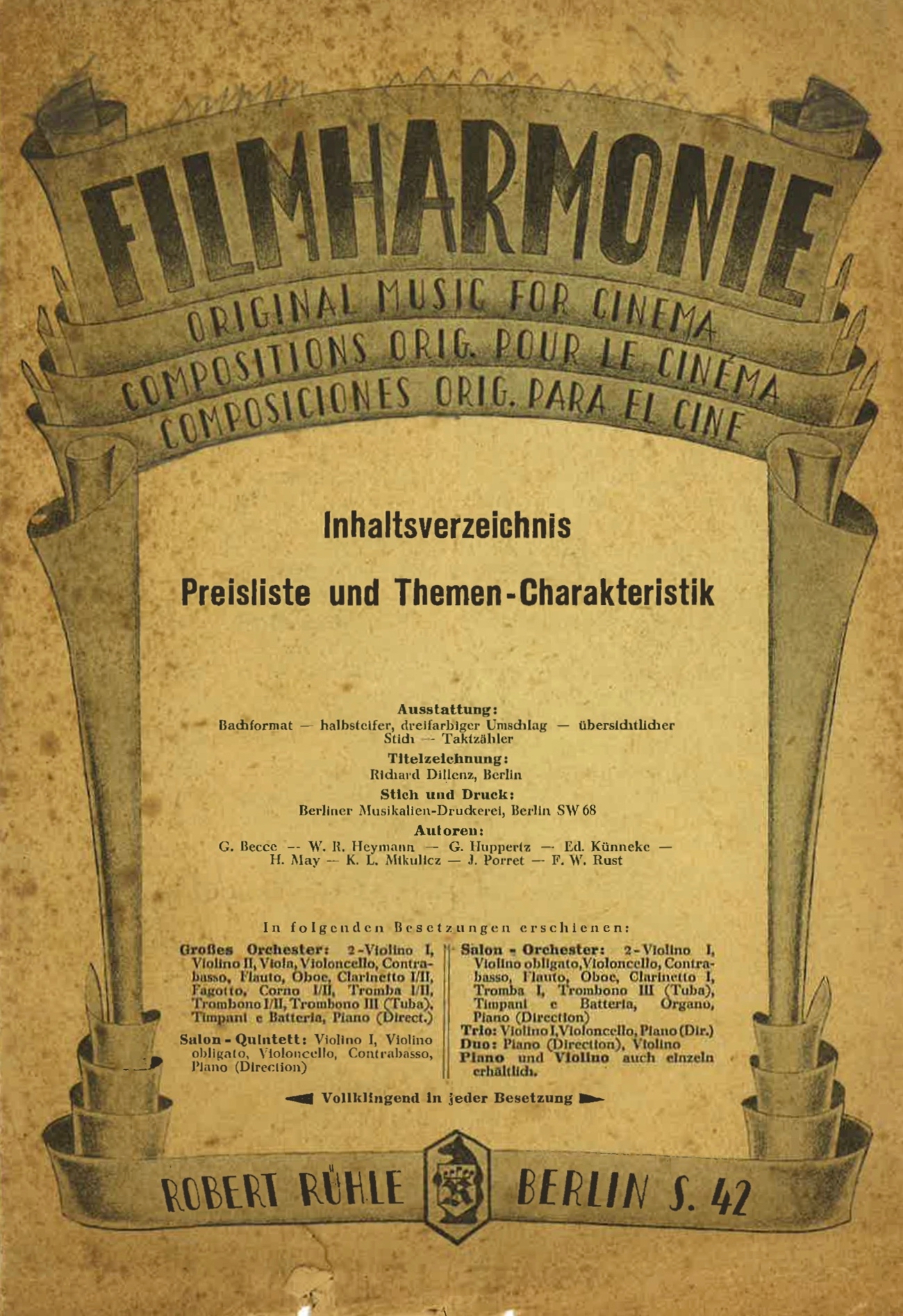
Der Musikbestand enthält über 500 Orchestersets aus deutschen, englischen und amerikanischen Kinomusik-Repertoires der Stummfilm-Epoche (bspw. Kinothek, Preis-Kino-Bibliothek, Boheme Kino-Lexikon, Sam Fox Film-Gebrauchs-Musik, Bosworth’s Internationales Kino-Orchester, J. S. Zamecnik’s Photoplay-Edition, Universal-Film-Musik, Robbins Red Seal Concert Series, Filmharmonie und vielen anderen). Ein solch umfangreiches Kompendium erlaubt einen historischen Einblick in die alltägliche Praxis der Stummfilm-Musik und kann Filmmusikforschern bei der Rekonstruktion der zeitgenössischen Technik und Ästhetik der Filmkomposition helfen.

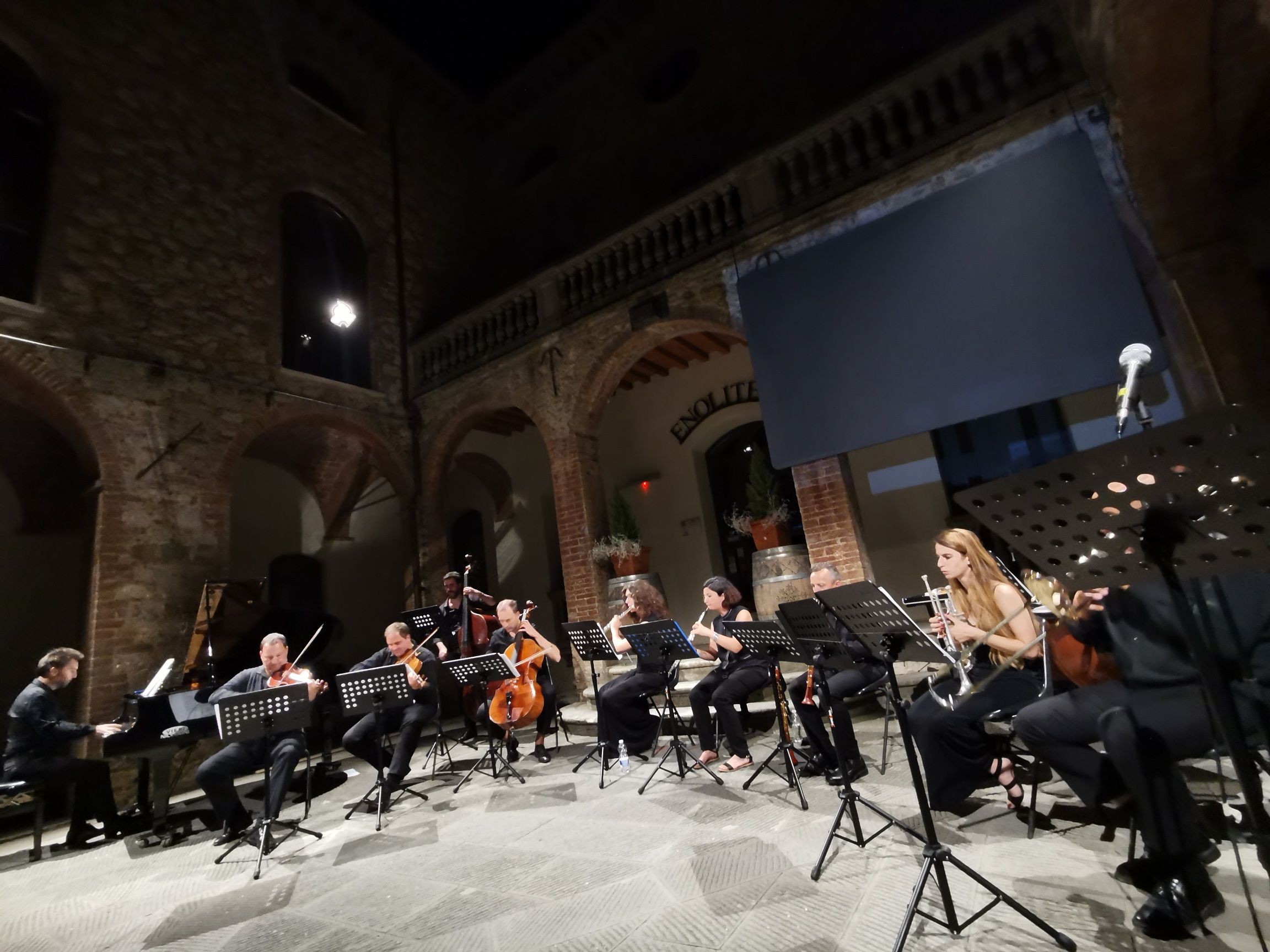
Dr. Francesco Finocchiaro, Leiter des FWF-Forschungsprojekts Filmmusik als Problem im deutschsprachigen Journalismus (1907–1930), hat diesen Musikbestand im Rahmen eines Lecture-Recitals vorgestellt: Der Vortrag wurde von der Live-Musikaufführung ausgewählter Kinomusikstücke durch ein Kammerensemble flankiert.

Die Filmmusik von gestern, a lecture-recital of Francesco Finocchiaro at Campus aktuell 2019, University of Vienna, June 13th, 2019. With the participation of Daniele De Vecchi, Anna Tonini Bossi, and Tiziana Columbro.

Film Music as Propaganda

Italian cinema of the fascist Ventennio (1922–43) used music and, more generally, the acoustic component in an anything but naive way: on the contrary, it focused on the most subliminal component of the filmic text so as to convey constellations of meaning that were useful to the regime’s cultural politics.

The musical component proves to be a strategic ideological tool especially in films with declared propaganda content. Fascist ideology translates into a pervasive musical polarization. On the one hand, music enhances fascism’s propagandistic myths, such as Latinity, Risorgimento, family, peasant land, war, etc. On the other, music is put in the service of anti-Communist, anti-Jewish, as well as anti-Ethiopian iconography, connoting spaces and environments, criminalizing the regime’s enemies (Africans, Marxists, Jews, etc.) through dissonances, cacophonic clusters, as well as the deformation of ethnic and jazz music.

The musical component of fascist cinema contributed toward structuring the regime’s rhetoric for all intents and purposes. Analysing the musical construction of spaces and places in the regime’s cinema can help reconstruct a fundamental chapter, so far neglected, of fascism’s cultural encyclopaedia.

Film Music as Propaganda: The Musical Construction of Space in Fascist Cinema was the title of an interdisciplinary panel conducted by Francesco Finocchiaro together with colleagues Leo Izzo and Elena Mosconi at the international conference Mapping Spaces, Sounding Places. Geographies of Sounds in Audiovisual Media, at the University of Pavia-Cremona (19-22 March 2019).