


Rediscovering the pleasure of a warm, joyful, and respectful educational relationship… Some pictures from Francesco Finocchiaro’s Erasmus Teaching Mobility at the University of Catania (15–26 April 2019).

Rediscovering the pleasure of a warm, joyful, and respectful educational relationship… Some pictures from Francesco Finocchiaro’s Erasmus Teaching Mobility at the University of Catania (15–26 April 2019).

Gottfried Huppertz’s score for Fritz Lang’s Metropolis (1927) is distinguished from other contemporary film music accompaniments in its use of sophisticated compositional techniques of a Wagnerian origin. Huppertz makes use of complex harmonies, chromatism, enharmony, and employs whole tone chords and scales. He also has the gift of a cantabile quality and uses it to elaborate a dense network of leitmotifs, which constitute the connective tissue of the score. In the musical vocabulary employed by the composer, however, there are also, and not without surprise, dance music pieces, which tend to constitute separate stage-music numbers. In two of these scenes –– both set in the Yoshiwara, the nightclub of Metropolis –– jazz takes on a peculiar significance. Towards the end of Act I, jazz music accompanies the astonishing vision that, during a trip by car, the worker Georgy has of the Yoshiwara hall. In Act ii, a foxtrot rhythm accompanies the seductive dance of the android with the features of Maria. In these scenes, which we can fully appreciate thanks to the complete reconstruction of the film carried out in 2010, Huppertz alludes to contemporary dance music through syncopated rhythms, jazz harmonies, the sound of the saxophone, etc. In the pseudo-Wagnerian style of Metropolis, the jazz of Yoshiwara represents a true and proper discovery. The two scenes above give us an entirely new idea of Huppertz’s music, which now appears to be richer and more complex. Beyond the stylistic and compositional aspects, however, there is something else. The use of jazz, indeed, proves fully consistent with the intentions of the narration. In Metropolis, jazz is associated with irrationality: an expressive means suitable for evoking a condition of sexual ambiguity, racial promiscuity, and corruption of moral values. The jazz music, thus, acquires an intentionally symbolic value with countless resonances in the cultural universe of the 1920s-Europe.
Francesco Finocchiaro and Leo Izzo: The Sound of the Nightmares: On the Jazz Music in Fritz Lang’s ‘Metropolis’. In Cinema Changes: Incorporations of Jazz in the Film Soundtrack, edited by Emile Wennekes and Emilio Audissino. Turnhout: Brepols, 2019, pp. 203–218.

One commonly speaks of “soundscape” to indicate a set of sounds connected to a particular environment. But does a “cinematic soundscape” exist? In other words: are there genuinely cinematic strategies to represent the sound of a territory, an environment, a geographical space? What is the link between music, the film of which the latter is part, and the space represented therein?
This fascinating knot of questions was the topic of the conference “Mapping spaces, sounding places. Geographies of sounds in audiovisual media “, hosted by the University of Pavia’s Department of Musicology, located in Cremona, from 19 to 22 March 2019.

Die Fachbereichsbibliothek Musikwissenschaft der Universität Wien verwahrt seit 2018 den Nachlass des deutschen Komponisten und Kinokapellmeisters Edgar Haase (1901–1967).
Der Musikbestand enthält über 500 Orchestersets aus deutschen, englischen und amerikanischen Kinomusik-Repertoires der Stummfilm-Epoche (bspw. Kinothek, Preis-Kino-Bibliothek, Boheme Kino-Lexikon, Sam Fox Film-Gebrauchs-Musik, Bosworth’s Internationales Kino-Orchester, J. S. Zamecnik’s Photoplay-Edition, Universal-Film-Musik, Robbins Red Seal Concert Series, Filmharmonie und vielen anderen). Ein solch umfangreiches Kompendium erlaubt einen historischen Einblick in die alltägliche Praxis der Stummfilm-Musik und kann Filmmusikforschern bei der Rekonstruktion der zeitgenössischen Technik und Ästhetik der Filmkomposition helfen.
Dr. Francesco Finocchiaro, Leiter des FWF-Forschungsprojekts Filmmusik als Problem im deutschsprachigen Journalismus (1907–1930), hat diesen Musikbestand im Rahmen eines Lecture-Recitals vorgestellt: Der Vortrag wurde von der Live-Musikaufführung ausgewählter Kinomusikstücke durch ein Kammerensemble flankiert.
Die Filmmusik von gestern, a lecture-recital of Francesco Finocchiaro at Campus aktuell 2019, University of Vienna, June 13th, 2019. With the participation of Daniele De Vecchi, Anna Tonini Bossi, and Tiziana Columbro.


Italian cinema of the fascist Ventennio (1922–43) used music and, more generally, the acoustic component in an anything but naive way: on the contrary, it focused on the most subliminal component of the filmic text so as to convey constellations of meaning that were useful to the regime’s cultural politics.
The musical component proves to be a strategic ideological tool especially in films with declared propaganda content. Fascist ideology translates into a pervasive musical polarization. On the one hand, music enhances fascism’s propagandistic myths, such as Latinity, Risorgimento, family, peasant land, war, etc. On the other, music is put in the service of anti-Communist, anti-Jewish, as well as anti-Ethiopian iconography, connoting spaces and environments, criminalizing the regime’s enemies (Africans, Marxists, Jews, etc.) through dissonances, cacophonic clusters, as well as the deformation of ethnic and jazz music.
The musical component of fascist cinema contributed toward structuring the regime’s rhetoric for all intents and purposes. Analysing the musical construction of spaces and places in the regime’s cinema can help reconstruct a fundamental chapter, so far neglected, of fascism’s cultural encyclopaedia.
Film Music as Propaganda: The Musical Construction of Space in Fascist Cinema was the title of an interdisciplinary panel conducted by Francesco Finocchiaro together with colleagues Leo Izzo and Elena Mosconi at the international conference Mapping Spaces, Sounding Places. Geographies of Sounds in Audiovisual Media, at the University of Pavia-Cremona (19-22 March 2019).


Our workshop on silent film music at the IULM University Milan started right today with a class on film music restorations. (A breath of fresh air against stupididy and evilness!)
From March 11th to 15th, Francesco Finocchiaro will give a workshop on film music composition in the early 20th century, in the framework of an Erasmus Teaching Assingnment at the IULM University Milan.

The 44th Cantiere Internazionale d’Arte di Montepulciano (July 2019) is going to host a lecture-recital by Francesco Finocchiaro on “emotion & feeling” in silent film music. The show, with the participation of Julie Brown (Royal Holloway, University of London) and Elisabeth Trautwein-Heyman, will culminate in a live performance by the Montfort Quartett, directed by Klaus Nerdinger.
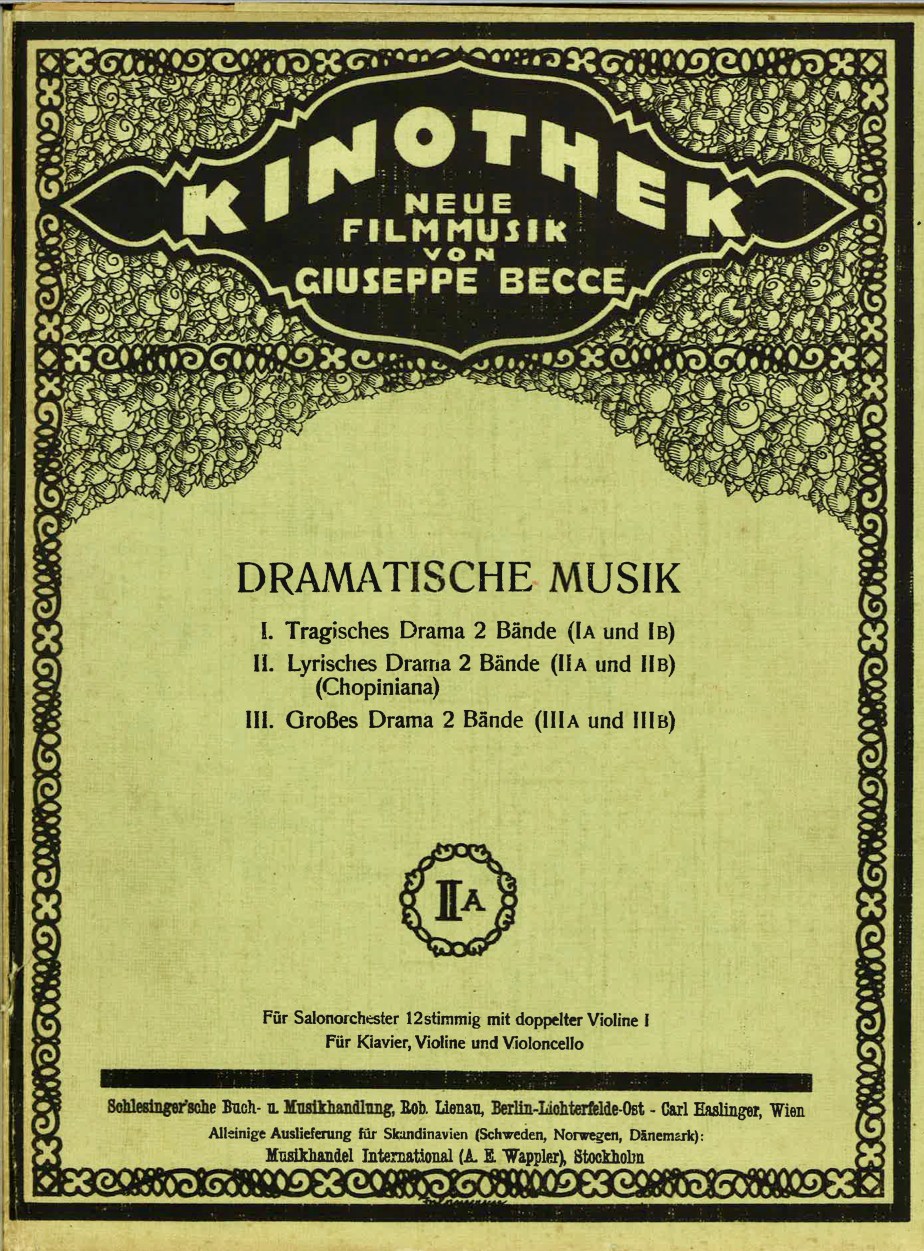
At the Musicological Department’s “Semesterfrüchte 2019”, Marlene Penninger, Marie Huber, and Chiara Schmidt performed “Notturno amoroso”, a film music piece drawn from Giuseppe Becce’s Kinothek (1919-26).
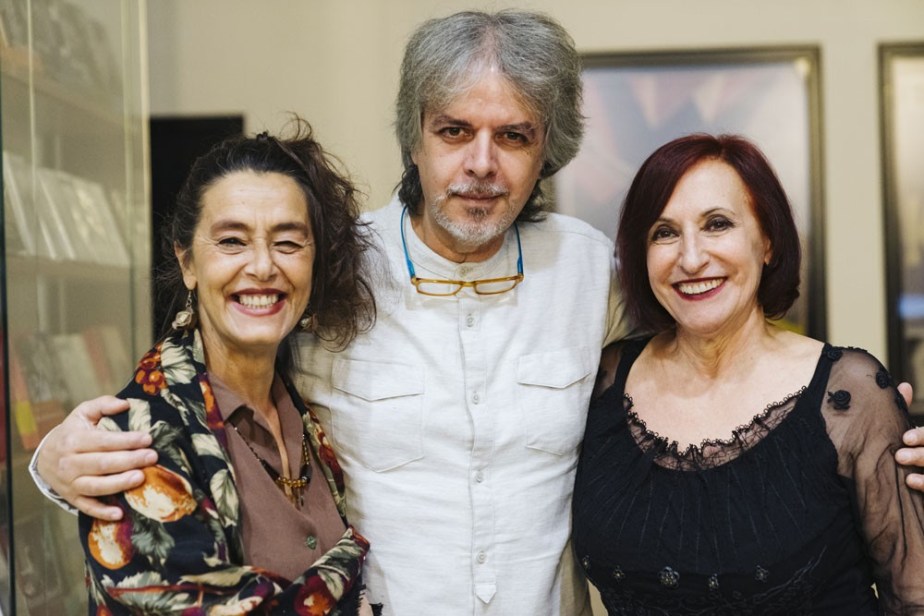
On November-December 2018, the Austrian Filmmuseum dedicated a film retrospective to Elvira Notari (1875–1946), the Neapolitan film pioneer of the early silent era. Italian folk music stars Lucilla Galeazzi, Dolore Melodia, and Michele Signore contributed to outstanding live musical accompaniments for the films ‘ A Santanotte (1922), È piccerella (1922), Fantasia ‘e surdato (1926), as well as Roberto Roberti’s masterpiece Napoli che canta (1926).

During the silent era, film theory assigned to music an essential role insofar as it claimed the birth and filiation of the so-called “tenth Muse” from the more ancient and noble “art of sounds.” The thesis of an elective affinity between music and cinema found a theoretical systematization in the writings of Georg Otto Stindt, Béla Balázs, and Hans Erdmann, who identified the rhythmic dimension as the trait d’union between these two forms of art.
Filmic rhythm, as Erdmann explains in the Allgemeines Handbuch der Film-Musik (1927), has a double nature. At a basic level, film rhythm comes into expression where scenic movements are being musically stylized through the principles of dance, march, as well as the motion of machines at work. In instances like these, the music closely follows the narrated events and establishes a painstaking correspondence with the visuals.
The artistic link between music and image, however, cannot be reduced to this mere descriptive illustration. This simple synchronization is nothing but a small-scale rhythm. The scenic events, indeed, unfold according to a line of feelings whose overall movement describes what Erdmman calls, in clear allusion to Eduard Hanslick, a large-scale rhythm. Music in cinema, thus, should not only adhere to the small-scale rhythm determined by the outer movements and the pantomime, but rather comply with the large-scale rhythm that underlies the narrated events. In the Allgemeines Handbuch, Erdmann names this structural rhythm with the term Eurhythmie, meaning nothing less than the temporal articulation of the film and its dramaturgical construction as a narrational curve.
Erdmann’s theory of a film rhythm and its significant implications for film music composition are discussed through the analysis of paradigmatic film sequences taken from Nosferatu (1922) by Friedrich Wilhelm Murnau and Metropolis (1927) by Fritz Lang.
Francesco Finocchiaro, “Im Anfang war der Rhythmus”. Aesthetic Abstractions in the Film Music Composition of the 1920s. In Ratio versus Intuitio, «Principles of Music Composing», XVII, 2018, pp. 145–156. (Read it on Academia.edu)
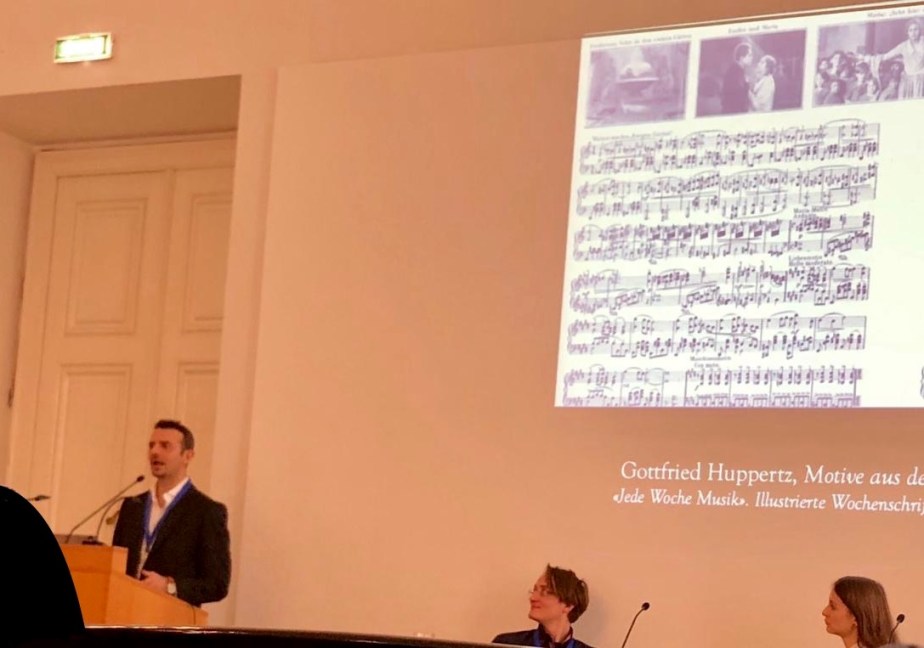
Der Begriff „Musikquelle“ stellt die Forschung im Bereich der Stummfilmmusik vor beträchtliche Probleme. Auf rein historischer Ebene muss zunächst darauf hingewiesen werden, dass der Großteil der Filme jener Zeit sowie viele ihrer Musikbegleitungen nicht mehr existieren. Handschriftliche Partituren mit der von ihrem Autor vorgesehenen Orchestrierung sind rar (ein geradezu einzigartiger Fall ist die Partitur von Gottfried Huppertz für Fritz Langs Metropolis, 1927); häufiger haben sich Klavierauszüge erhalten (zum Beispiel jene von Edmund Meisel für Panzerkreuzer Potemkin von Sergej Eisenstein, 1926), doch diese wurden meistens in einem anderen Zusammenhang und zu einem völlig anderen Zweck produziert. Im Gegensatz dazu ist aus der Stummfilm-Epoche ein großes Repertoire an Stimmungsmusiken überliefert, die ihrer Natur nach entweder einer „musikalischen Illustration“ vorausgehen oder von dieser a posteriori abstammen konnten (wie im Falle der Fantastisch-romantischen Suite Hans Erdmanns, abgeleitet von der Begleitmusik zum Murnau-Film Nosferatu, 1922).
Musikalische Dokumente solch vielfältiger Faktur, die ganz unterschiedliche Momente im Arbeitsprozess einnehmen konnten, werfen weitere Deutungsprobleme auf, wenn sie den Ausgangspunkt für Filmrestaurierungen bilden. Die Musikquelle tritt dann in Beziehung, oder viel häufiger in Kollision, mit einer Quelle anderer Art: der Filmrolle. Diese beiden Dokumente haben einen jeweils anderen ontologischen Wert – oder um ein Begriffspaar Ecoʼschen Ursprungs zu verwenden: Die Musik eines Stummfilms kann als „offener Text“ bezeichnet werden, der bei jeder Live-Aufführung erneuert wird; der Film ist hingegen ein „geschlossener Text“, der mechanisch, nahezu identisch bei jeder Projektion wiedergegeben wird. Hinzu kommt, dass die Autoren dieser beiden Texte je einen unterschiedlichen Status einnehmen: Der Filmemacher unterzeichnet den filmischen Text in jeder Hinsicht; der Komponist betreut stattdessen eine ergänzende Komponente nicht des filmischen Textes, sondern der filmischen Projektion.
Im Gegensatz zu einer emphatisch aus zumeist kommerziellen Gründen proklamierten Authentizität muss man feststellen, dass der Rekonstruktionsprozess oft recht arbiträre Eingriffe in die musikalischen Dokumente erfordert – was jeweils verschiedene Optionen in Bezug auf den ontologischen Status der Partitur und der Filmrolle sowie deren Autorschaften impliziert. Selbst wenn erklärt wird, die vermeintliche „Uraufführung“ im Namen medienarchäologischer Bestrebungen wiederherstellen zu wollen, erweist sich jede Rekonstruktion eines Stummfilms, insbesondere im Dienste einer modernen DVD-Edition, als ein Übersetzungs- und Adaptionsprozess. Das Endresultat ist nicht nur historisch neu und nicht unmittelbar aus dem Zustand der „Quellen“ ableitbar, sondern auch ganz in der ästhetischen Erwartungshaltung der Gegenwart verwurzelt.
Francesco Finocchiaro, Aporien der Filmrestaurierung: Die musikalischen Dokumente der Stummfilm-Zeit zwischen Medienarchäologie und Marktgesetzen, Annual Conference of the Austrian Musicological Society, Vienna, 6–8 December 2018


You must be logged in to post a comment.